
white girl warfare
on my "LOST LAMBS" review for New York Magazine

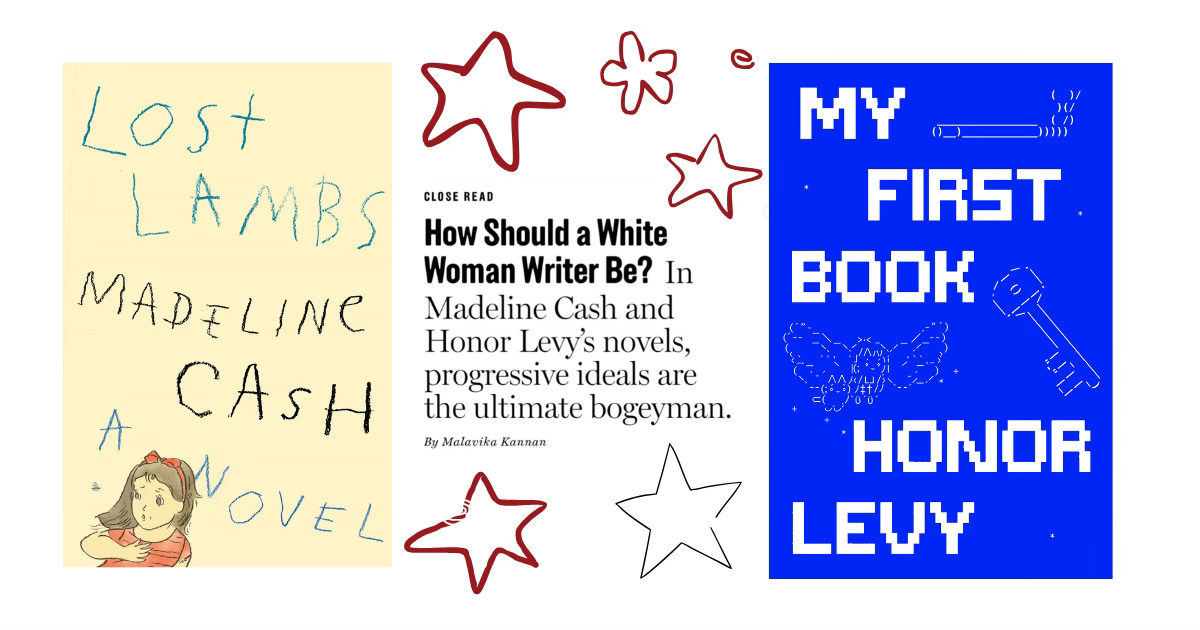
Last week I published my first literary criticism essay in New York Magazine, “How Should A White Woman Writer Be?” It explores the invisible white racial politics in Madeline Cash’s Lost Lambs, Honor Levy’s My First Book, and the Dimes Square literary scene more broadly! Whiteness, to me, was a central preoccupation of these novels, and I was shocked that no mainstream reviews seemed to clock it, so I decided to write the analysis myself. It received a much bigger response than I was expecting, especially as a newer writer! I love essays as a form, standalone, but also because of their capacity to generate conversation, so I thought I would continue that conversation here and share some thoughts on criticism, race, and the future of Gen Z and internet literature more broadly.
To me the point of book criticism is, primarily, to entertain. At least, that’s why I read it! It’s been a hard news cycle (it always is), and I wanted to give the girls something to giggle about in their groupchats. My goal was not, as some commenters put it, to “cancel,” an allegation so overused that for many Gen Z writers, including the ones I critique, the statute of limitations has long expired to take it seriously! I have a sense of loyalty to young women, and while it’s possibly un-feminist to hold punches just because someone’s a woman, I did exercise judgement on which authors might have the infrastructure to withstand friendly fire. There is a well-documented literacy crisis afflicting my generation, and I think it’s overall a good thing that books like Lost Lambs are getting the girls gassed up. Despite the title, which I did not pick (it is a clever reference to Sheila Heti, who also catches strays), I know it’s not my place to tell anyone what they should write. I have never listened to anyone who told me how to write, anyhow …
But what I do think is my place, as someone who cares deeply about literature, is to widen the terms of engagement with it, open more doors and windows for people to consider their relationship to our shared narratives. My essay was inspired primarily by Toni Morrison’s text Playing in the Dark: Whiteness and the Literary Imagination, in which she calls for more critical assessment of whiteness, too often treated as default or invisible, in American literature. Morrison asserts that seemingly race-neutral American literature is nonetheless shaped by an “Africanist” presence, a self defined against the Black other, and to ignore race “risks lobotomizing literature.” She’s not asking necessarily white people to falsely overextend their imagination: for them to “situate black people throughout the pages and scenes of a book like some government quota, would be ludicrous and dishonest.” But she can’t help but contemplate how their literature is nonetheless shaped “by its encounter with racial ideology.” “It requires hard work not to see this,” she adds.
I wanted to expand Morrison’s argument for 2026 to argue that the other is now a more nebulously-defined force, comprising people of color and queers and women who’ve been drafted into algorithmic coalition together, and are now collectively dog-whistled towards with words like “woke” or “DEI,” which are pretty much slurs when coming from certain mouths. I have some skin in this game because woke people are, in all our annoying-ness, my people. I remain painfully alert to how the specter of wokeness is addressed in contemporary literature — maybe you will now, too!
There’s a passage in Playing in the Dark I found particularly inspiring, when Morrison describes her transformation from reading as a reader, to reading as a writer:
“It is as if I had been looking at a fishbowl — the glide and flick of the golden scales, the green tip, the bolt of white … and suddenly I saw the bowl, the structure that transparently (and invisibly) permits the ordered life it contains to exist in the larger world. In other words, I began to rely on my knowledge of how books get written, how language arrives, my sense of how and why writers abandon or take on certain aspects of their project.”
I wanted to try criticism because I am a writer, not just a reader. I can see, and enjoy, the fishes, but I can’t un-see the fishbowl, which I have been banging my head against for years. I felt I had a certain understanding of Cash and Levy’s writing processes, as a young (although solidly Gen Z, not zillennial) female novelist and internet native who is swimming in a similar soup as them. As a Gen Z reader, I came to criticism with the suspicion that the politics of self-presentation are at the core of writing and receiving novels. (Let’s be real: even as older generations die on the hill of separating art from its artist, younger writers know that ship has sailed. With digital footprints, it’s part of the fun!)
I became interested in the internet of it all while researching my forthcoming collection of essays, RAGE BAIT. Online, it’s been well-documented by researchers and journalists that certain tactics, such as shitposting, irony, and provocative jokes, delivered in a way that covers your ass while weeding out anyone who doesn’t have the tolerance for racism, are used by the far-right to shift the terms of internet discourse. It’s been wildly successful: online meme warriors reconfigured the Republican Party from one that avoided racist allegations, to one that runs on them. I was struck by the parallels between this far-right internet project and the aesthetics bubbling up in a certain crop of novels. I had my suspicions of which side of the internet, which FYPs and algorithms, these books were marinated and ideated in conversation with. I knew which echo chamber these girls had jail-broken from; I loathed which politics lay in the opposite direction.
That was, if anything, the moral impetus behind my essay (although fun was still the #1 priority.) I wanted it to be said aloud that this rightward shift in literary aesthetics does not exist in a vacuum. I didn’t think the politics of Lost Lambs were subtle, but they nonetheless evaded the notice of most mainstream reviewers, not to mention the well-meaning liberal millennials who are currently the gatekeepers of literature. Right now, edgy whiteness is like a high-pitched frequency that certain people are likelier to hear — maybe young wokes and queers, like me, who grew up alongside it online. I’m interested in how our cultural products, like memes and books, bring us home each night to see that our collective furniture has shifted three inches right, until one day the house we share is unimaginable.
But ultimately I did not seek to write from a place of moral authority. (Ironically, I was getting cancelled the same week that the piece came out, but by a totally separate community — online queers of color, lol.) Just as edginess, I’ve argued, is the least interesting aesthetic for white women to take, I think that self-righteousness is the most boring, cramping aesthetic for writers of color — what Morrison refers to as “rallying gestures at fortress walls.” I don’t think writers of color should only feel comfortable running our mouths if we are totally morally unimpeachable, or writing from the credentials of victimhood or trauma. (That’s the essay for next time, lol!) The fact is that no Americans, not even woke ones, have clean hands.
Agency, complicity — these are the questions that vex me as an American writer. My personal opinion on how a white woman writer should be is also how I want to be. For what it’s worth, I’m not too different from these writers (my essay was Zoomer-on-Zoomer crime), and I occupy a similar ambivalent middle-spot as white women in America’s privilege hierarchy. A practice I’m cultivating in my nonfiction: I try to read it through the POV of every person who might encounter it, including ungenerous or evil people. I want my choices to withstand both friendly and unfriendly fire. I consider how specific lines might look as tweets, taken out of context, which inspires an economy in language; every sentence needs to bang, because it could get written on your gravestone! These might be the crazy acrobatics of writing in the internet generation, but I think it strengthens my writing. I can no longer assume a default POV from my reader, white or woke or otherwise. If this is mental gymnastics, I am training to become an Olympic athlete. (Is that not a writer’s job?)
I know the karmic boomerang might come to get me; I am steeling myself to face the merciless gendered reader-projection spectacle when my own debut novel comes out in August. (The author is no longer dead, as Roland Barthes put it, but chronically online!) But I’m not too worried. My villain origin story, as some of you might know, is that I used to face off against evil Republican politicians as a teenage gun violence activist in Florida. My sense of stakes, and nervous system, were permanently shaped by this experience, and now few things online bother me anymore, let alone bad book reviews. (But I do like getting nice emails from readers — thanks to all who contacted me. I, too, am a shameless cold-emailer of writers I admire. I notice men tend to cold-email me more, which is a credit to them … also time for more women in male dominated fields, as they say!!)
If you liked this, please consider pre-ordering my novel, UNPRECEDENTED TIMES! It’s a Gen Z campus novel taking place during the pandemic. It also grapples, FWIW, with the specter of the internet, crumbling American dream, all manners of woke!
OK, I wasn't a fan of the Vulture piece, but I have to give you props for defending your essay -- and contextualizing it -- in this follow-up.
I think that what I and other critics of your Vulture piece object to is a strained adherence to a checklist of political correctness initiatives that every work of literature, art, political project seems to need to conform to. Like, every novel has to begin with a land acknowledgement and we have to put one person of every race, sexual orientation, and economic class (and don't forget the disabled!) in the book for fear of being insufficiently inclusive.
If wokeness amounts to this checklist, and a lot of people view it this way, then of course people on the right, center, and left, will object to wokeness.
Your essay recurrently uses "white woman" and "whiteness" as though it were a kind of slur, and seems to demand of white women the very "self-flagellating acknowledgment of progressive politics" that you also find off-putting. Instead of reading these books on their merits, this essay is obsessed with the question of: "Are these white women sufficiently in support or not of the progressive cause?"
I don't see that as an interesting lens to frame an analysis of these texts, and the whole project is the kind of crybullying that turns people off to "wokeness."
This is a critical comment about your writing, but I'm not trying to be mean here. I want to articulate for you why it is (some) people have an issue with your piece
If feedback is OK, I think you could have taken a little space to explain your theory of the case, instead of just talking about Whiteness as a well-defined literary concept. Just pointing to Whiteness and pointing out that a certain rhetorical strategy is also used by some Right-wingers is, like, half an argument at best.